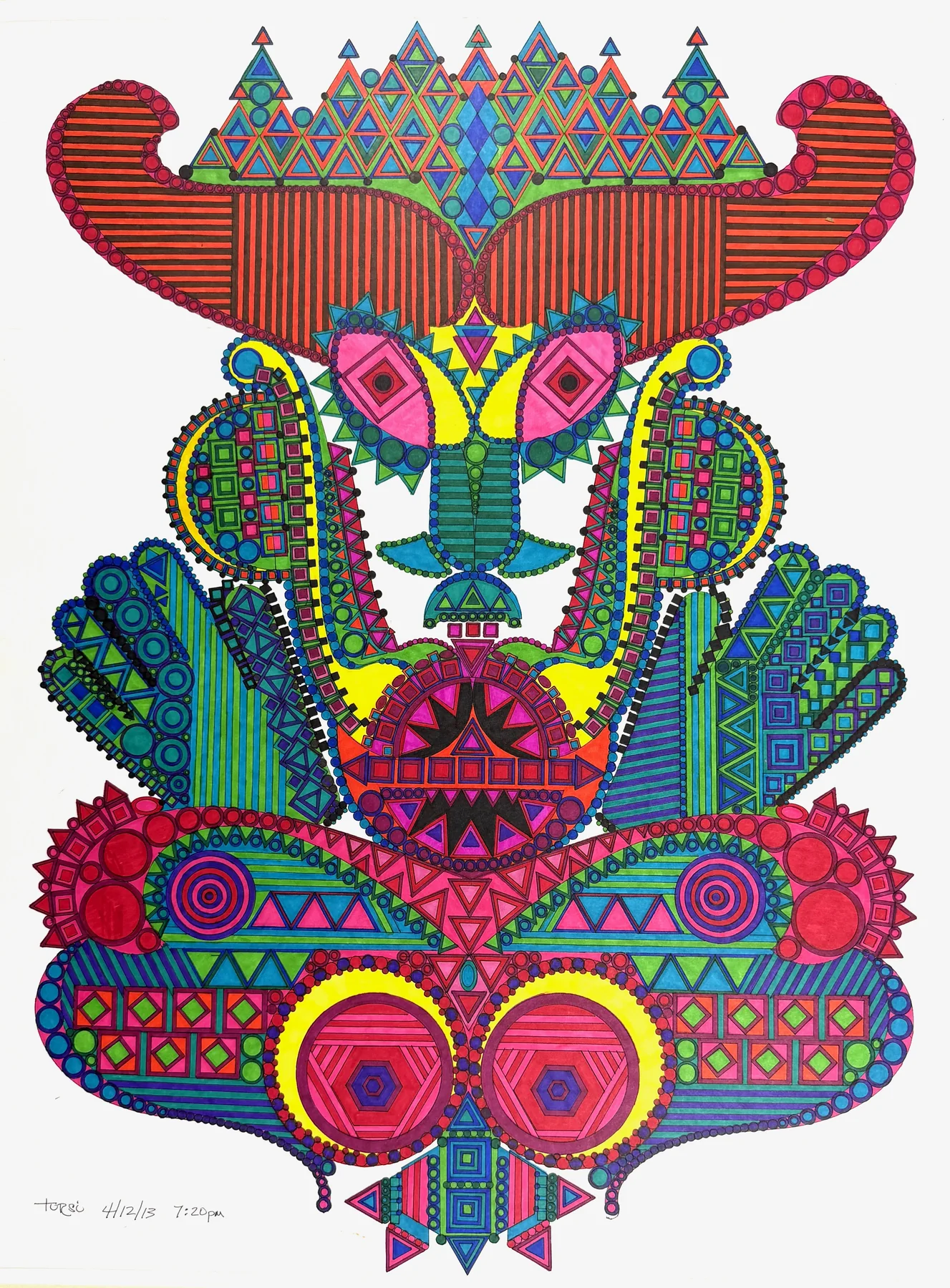
“Welcome to Tursi World!” artist John Tursi proclaims to visitors entering his universe.
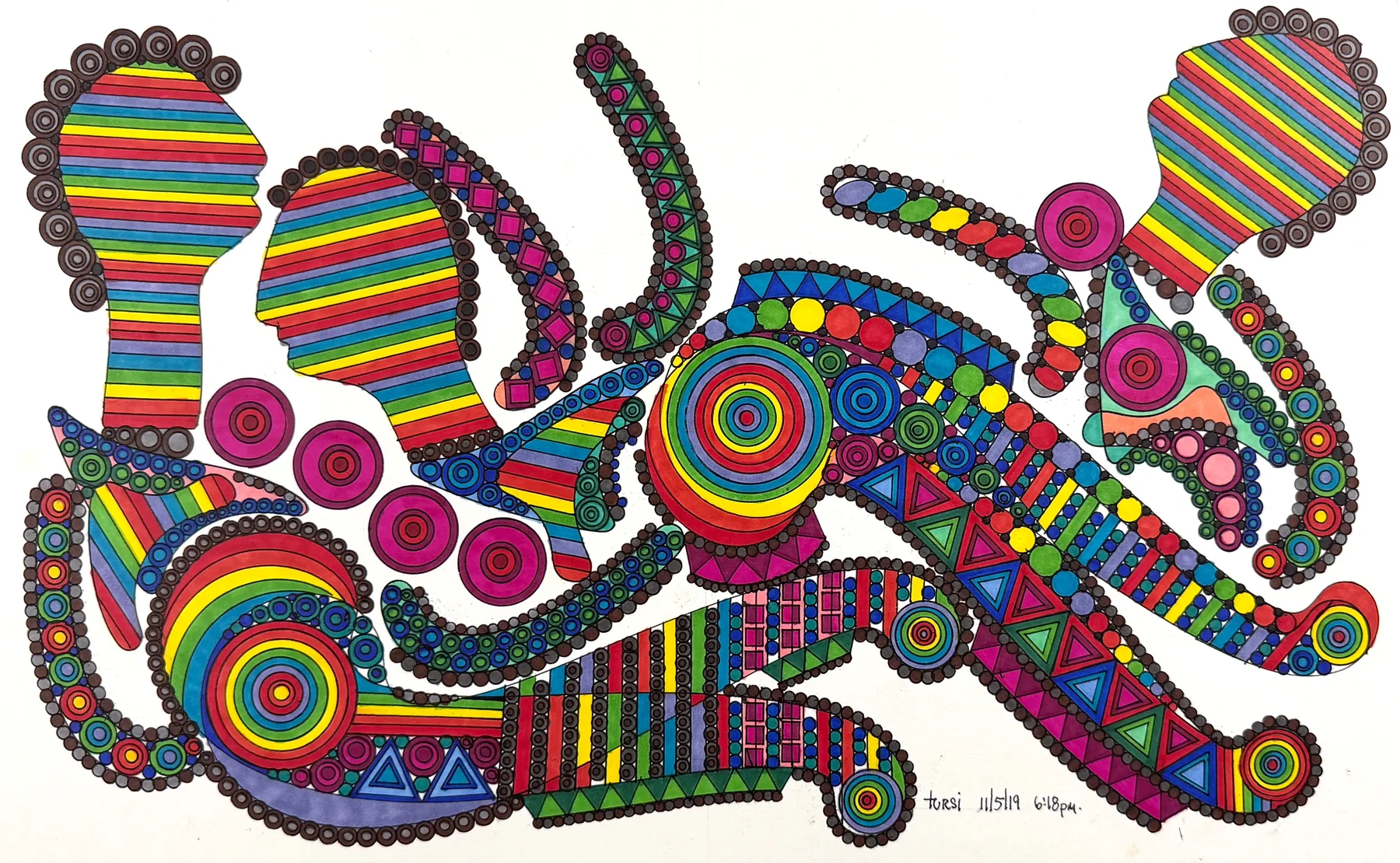
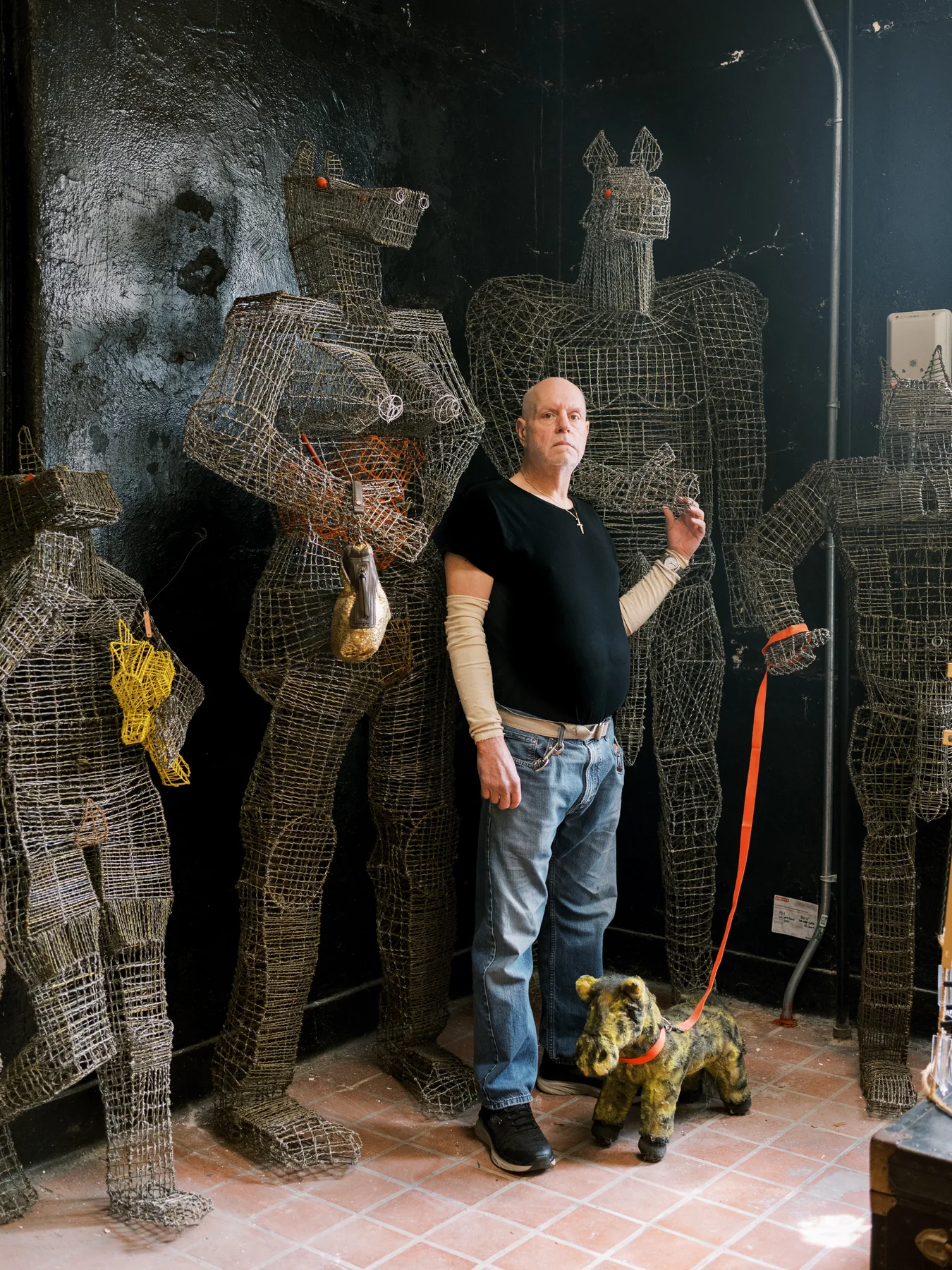
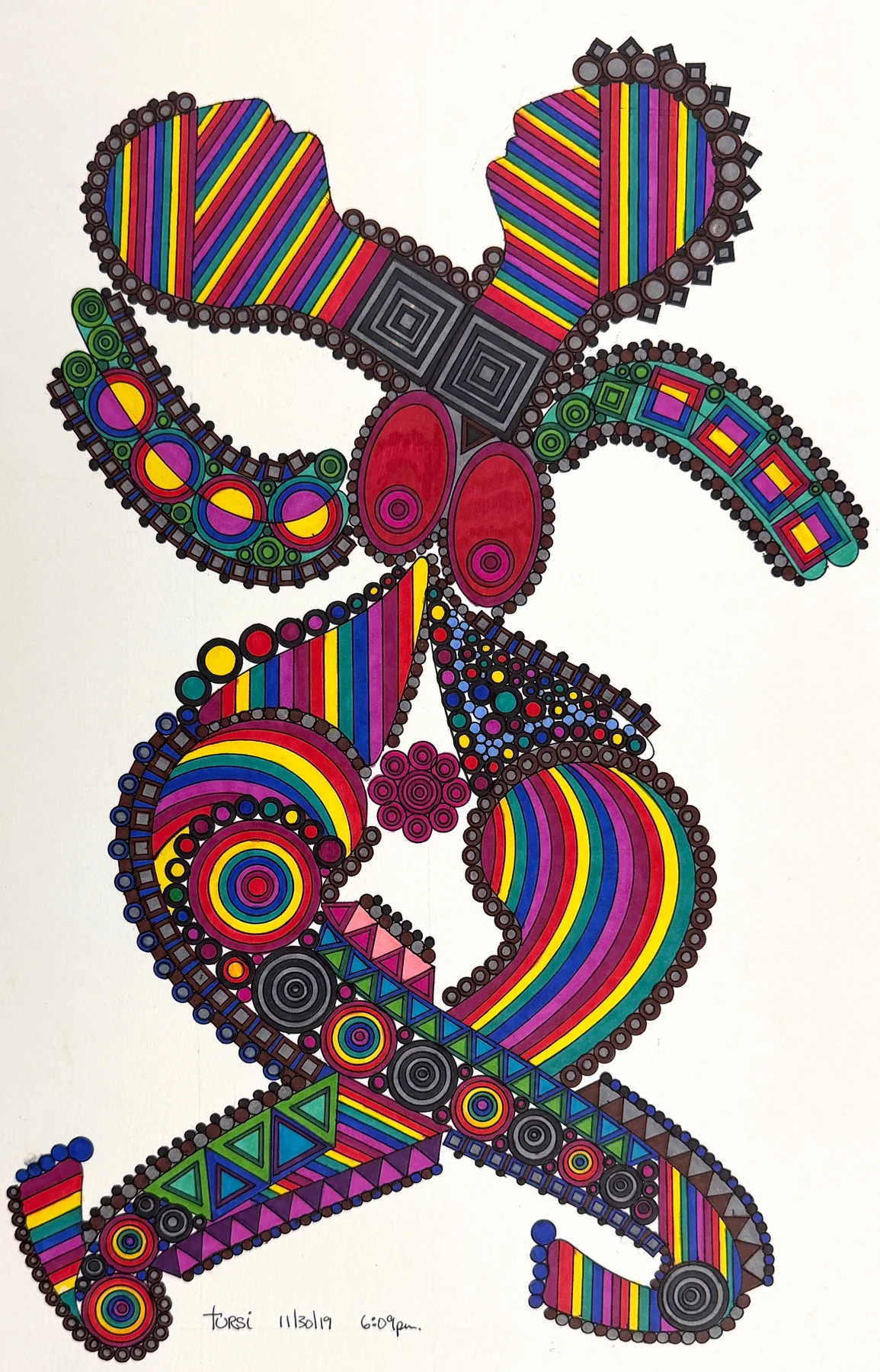
Tursi World, native population one, welcomes all who venture across its threshold. Tursi World is a polymorphic, full-spectrum panoply of human experience and interaction. Glam rock dancers drawn with architectural precision, each a riotous rainbow of color, twist and cavort in psychosexually charged couplings, triads, and other configurations. Ruled by The Mighty Horse Family, a quartet of larger-than-life wire equine deities posing as a conventional nuclear family, Tursi World hums to its own galactic rhythm, a hallucinatory beat orchestrated by its singular maestro.
John Tursi, born to working class Italian-American parents in Queens, NY in 1961, has lived a life externally organized around psychological diagnoses, roadblocks to achieving what in contemporary American society merits success. Like other artists of his generation, Tursi takes an industrious approach to his craft, creating daily over decades. His drawings, done with marker and ink, appear digitally composed, all dazzling opticality and rigid lines, though their design is organic, unplanned, and hand-drawn. His sculptures are larger than life figures made from metal clothes hangers and wire. They float in their own astral plane, massive yet feather-light in the breeze. Tursi is a prolific, stalwart creator who cannot be bound by psychological norms and the restrictions that narrowly define human experience and psychic life.
Tursi World for the past thirty some years has been situated primarily at The Living Museum, a studio facility at Creedmoor Psychiatric Center, the largest state-run mental hospital in New York City, where the artist has worked since the 1990s. The Living Museum too runs on cosmic energy, providing refuge for artists who at one time or another have found themselves patients in the decidedly less expansive realm of the public psychiatric institution.
Tursi speaks often of his destiny. Destiny for an artist can take a myriad of forms, some of which he has achieved. Reviewing a 2002 Queens Museum show, Roberta Smith in The New York Times wrote that he “comes closest to genius status.”1 He has shown his work in galleries and museums in New York and beyond. For Tursi, destiny includes, but is not limited, to such recognition for his work. Unnamed magic will transpire once destiny is achieved. Time and space will be bent and global harmony reached. Artistic destiny is about both creation and recognition; the freedom to create one’s own world and the very human desire to be seen. Achieving destiny is not simple, nor does it come without enduring fantastic hardship.
Destiny is an appealing container for Tursi’s personal and artistic trajectory, and for Tursi World to herald the launch of a new museum rings of destinies fulfilled. Open Museum, America’s first museum dedicated to artists with disabilities working in supportive studios, alights upon the Miami Design District for a spell this December, welcoming all to its generous and generative universe. Open Museum is for artists who live and work beyond the structures that exist to create and maintain difference, to isolate those whose paths do not follow the strictures of the mainstream. We welcome you to Tursi World, and invite you to enter our Open Universe, where every day we expand our ideas of who can achieve their destiny.
David FiermanCo-founder and Artistic Director, Open Universe
- 1Roberta Smith, “Art Review; Who’s to Say Where Inside Meets Outside?” The New York Times, March 29, 2002. nytimes.com (opens in a new tab) ↩